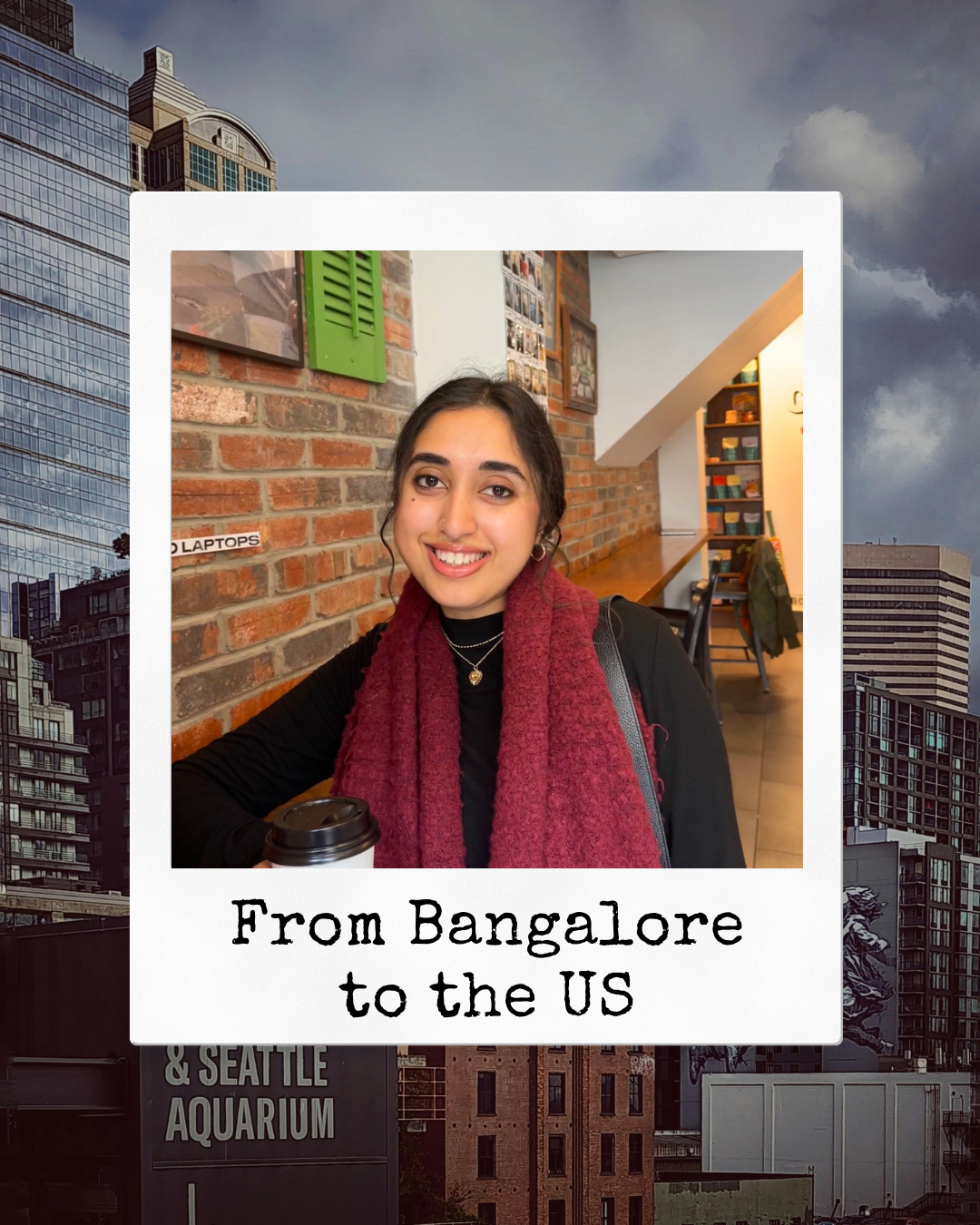
Runaway Daughter: The viral story of an Indian woman learning to belong abroad
Moving across continents once felt like an adventure reserved for adulthood, but for Niharika Manda, the journey began at 12, when her family left California for Bangalore. Years later, she moved back to the US on her own for college, carrying two cultural identities shaped by two homes.
In this interview with Indian Women Abroad, she opens up about navigating life between worlds, building a career in tech and storytelling, confronting the loneliness of early immigration, and learning to define “belonging” on her own terms. Her reflections are honest, tender, and deeply relatable to anyone who has ever felt suspended between two cultures.
Where are you from in India, and where did you move?
I always say my story is a little unconventional! I was born in California, but I grew up in Bangalore after my family moved back when I was 12. So in a way, both places have shaped me. I moved back to the US on my own for undergrad at University of Illinois Urbana Champaign near Chicago, and later moved to Seattle for work.
What prompted your move?
I moved for college! And now I’m a writer and a product marketer. I moved to the US to pursue my undergraduate degree in Computer Science, Linguistics, and Creative Writing. After graduating, I worked as a software engineer at Amazon and Salesforce before transitioning into product marketing earlier this year. The shift has allowed me to combine my technical background with my interest in storytelling and creative marketing.
What was your experience of moving and adjusting to a new culture like?
Having lived in both India and the US before, the transition felt familiar yet different. Moving back as an adult meant taking full responsibility for my life and choices. There was an initial adjustment to cultural nuances and communication styles, but over time, I developed a sense of comfort navigating between both worlds.
What are the biggest pros of moving? What all lessons have you learned?
The biggest advantage has been exposure to new perspectives, disciplines, and people. Living abroad has taught me adaptability, independence, and the ability to build a life from the ground up. It has also deepened my appreciation for cultural duality by learning to hold space for both Indian and American influences in my identity. Achieving financial independence is also something my parents have always emphasised and encouraged. Being able to support myself and build a career on my own terms has been both empowering and fulfilling.
What are the biggest challenges you have faced?
My experience was not the easiest. I don’t think anyone’s immigration journey ever is. I often felt caught between two cultures, never fully belonging to either. There was a constant sense of being “neither here nor there.” I also struggled to find a community of women who had moved to the US on their own at a young age. Most people around me had come for graduate school or immigrated later with their families. At that age, it was difficult to chart a path without many examples to follow.
The most consistent challenge has been the distance from family, from cultural familiarity, and from the everyday comfort of home. Even after years abroad, moments of disconnection surface unexpectedly. Managing those emotions while staying focused on personal and professional growth has been an ongoing learning process.
Was it easy to adjust to a new environment? How did you find/build a social circle
Adjustment takes time. In college, friendships developed through shared classes, experiences, and interests. I was part of dance clubs, a cappella groups, and writing clubs where I met people who shared my creative passions. After entering the workforce, it required more effort and intentionality.
I built my social circle through work, creative communities, and other South Asian professionals navigating similar transitions. I’ve always gravitated toward people with creative interests or those who respect and appreciate my cultural background. More than a shared background, I’ve realised that I value shared principles and outlooks on life. Over time, I’ve learned that for me, being loved has always meant being seen, and that was enough to find a sense of community wherever I went.
You’ve also been creating content documenting some of this experience, what has that journey been like?
Creating content around my experiences began as a personal outlet but has grown into something much more meaningful. I once wrote a reflection called “Runaway Daughter” about feeling guilty while traveling in London wishing I could take my parents on my travels with me, yet knowing deep down that they were proud of me for living the life they always wanted me to have. That video ended up resonating far beyond what I expected, with almost 430,000 views and close to 10,000 reposts.
What meant the most, though, were the messages from women around the world who said they had felt the same way but never knew how to express it. Moments like that make me feel deeply grateful as a writer. There’s a special kind of fulfillment in being able to put words to emotions that are complex and universal.
You can read Niharika’s Substack article that she wrote about her immigration experience, relationship with her mother, and how it feels to belong to two places at once here.

Written by
Indian Women Abroad